

Disney reported results for its fiscal third quarter that topped expectations but revenue that came in just shy of analyst projections – as the company’s streaming business grew and its theme parks saw higher spending from consumers.
The growth in streaming has recently started to help to supplant the losses of the cash cow traditional TV business, which has been bleeding customers for years now.
Download NOW Q2 2025 Consumer sector L-Z including Disney evaluation
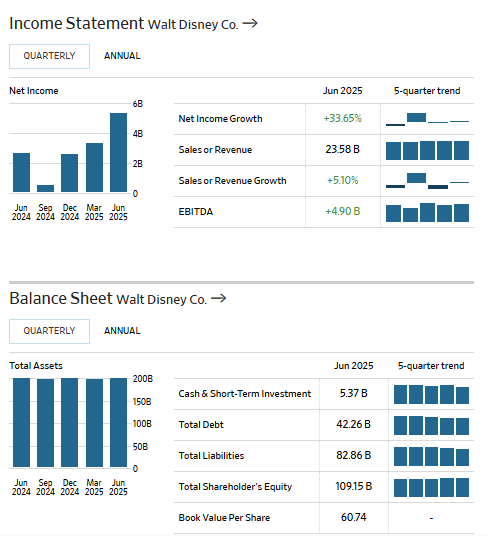
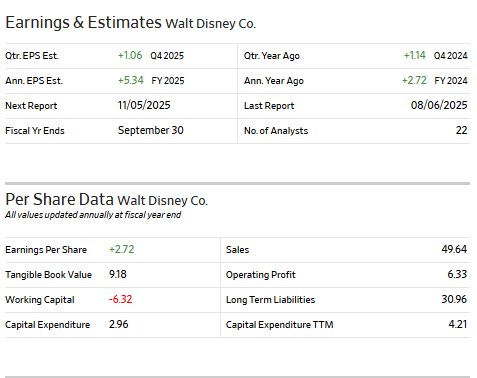
Net income for the quarter was $5.26 billion, or $2.92 per share, more than double the $2.62 billion, or $1.43 a share, that the company reported for the same period last year. Adjusting for one-time items, primarily related to tax benefits associated with Disney’s purchase of Comcast’s Hulu stake, Disney reported earnings per share of $1.61.
Disney’s overall revenue rose 2% to $23.65 billion, missing analyst expectations for the first time since May 2024.
The company reported continued growth in its streaming business despite headwinds in the traditional TV bundle, which has suffered from declining customers.
Disney upped its fiscal 2025 guidance and now expects adjusted EPS of $5.85 – an increase of 18% from fiscal 2024. In May, Disney issued guidance for expected full-year adjusted EPS of $5.75.
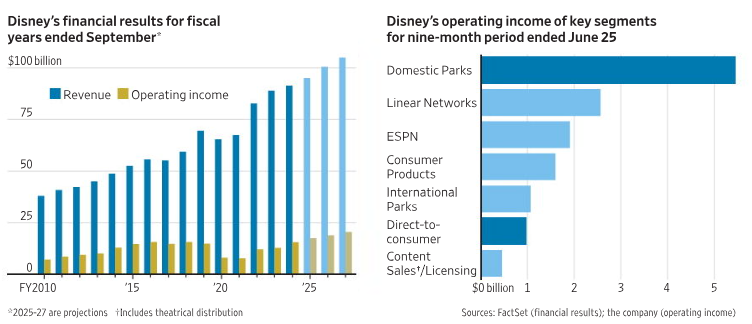
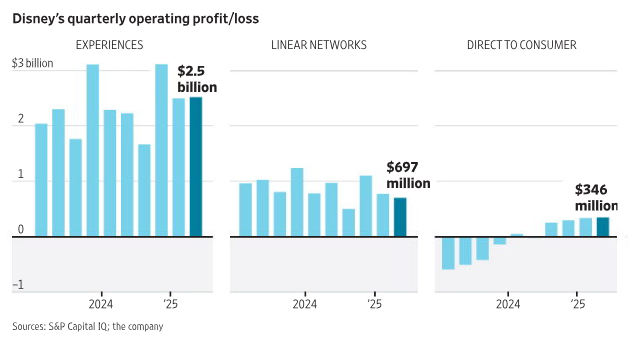
Revenue for Disney’s experiences segment, which includes theme parks, resorts and cruises as well as consumer products, increased 8% to $9.09 billion. Domestic theme parks revenue was up 10% to $6.4 billion, in particular as there was an increase in spending at theme parks and higher volumes in passenger cruise days and resort stays.
International parks and experiences revenue was up 6% to about $1.7 billion. In May, Disney announced it reached a deal to bring a theme park and resort to Abu Dhabi. The expansion into the United Arab Emirates is not part of the earlier Disney pledge to spend $60 billion on theme parks over the next decade.
Meanwhile, revenue for Disney’s entertainment segment, which includes traditional TV networks, direct-to-consumer streaming and films, was up 1% to $10.7 billion.
While revenue for the direct-to-consumer streaming business rose 6% to $6.18 billion, the entertainment segment as a whole was weighed down by the traditional TV business, which saw revenue dip 15% to $2.27 billion.
The direct-to-consumer streaming business was lifted, however, by the company’s flagship service, Disney+, which added 1.8 million subscribers, bringing its total to nearly 128 million. Total Hulu subscribers grew 1% to 55.5 million.
Domestic revenue for ESPN increased 1% to $3.93 billion, while its domestic operating income dropped 7% to $1.01 billion. Those results were impacted by higher programming and production costs, particularly due to NBA and college sports rights.
The traditional TV business once again dragged down the entertainment unit. Total operating income for the linear networks – which includes broadcaster ABC as well as pay TV channels like FX – fell 28% to $697 million, impacted by a decline in advertising revenue due to lower viewership and rates.