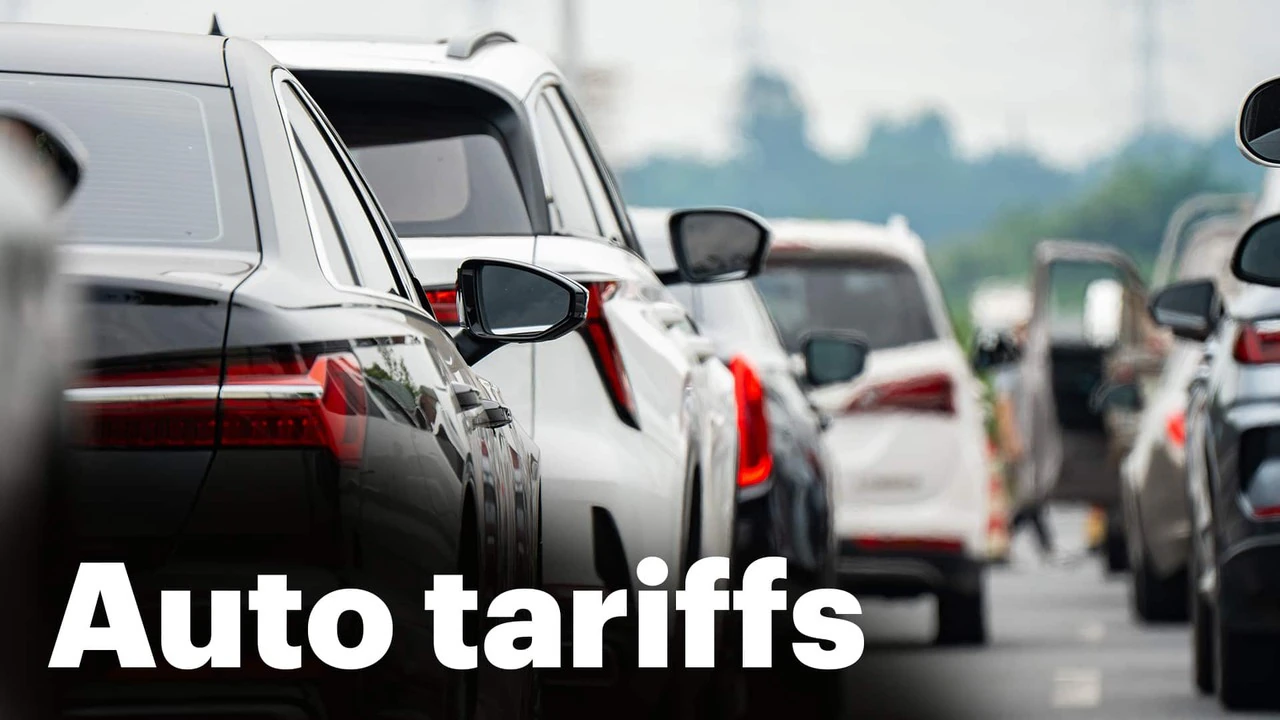
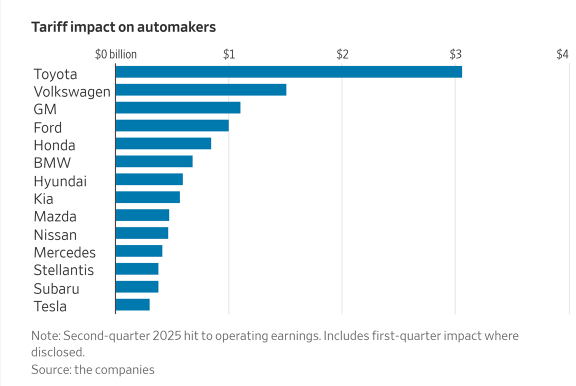
President Trump’s tariff war has inflicted almost $12 billion of losses on global automakers, the biggest hit they have faced since the pandemic. The scary reality: This may be just the beginning.
Beyond the continuing cost of tariffs, automakers in the U.S., Japan, South Korea and Europe face years of retooling and supply-chain tweaks to adjust to the new realities. This comes after they spent heavily to reshape factories for electric vehicles.
The obvious responses to tariffs are to raise prices and move production to the U.S. But both are hard for carmakers to do quickly, potentially saddling them for years to come.
Skeptics say the tariffs will only change the industry at the margins, with global automakers investing in the U.S. because of its healthy consumer economy, not its politics.
Still, White House trade policy may be accelerating an industry trend toward making cars closer to where they are sold. The big auto markets of North America, Europe and China are increasingly divided by different regulations, technologies and consumer preferences, encouraging automakers to design and manufacture locally.
Toyota forecast tariffs will create a $9.5 billion burden through its fiscal year that ends next March, leading to an anticipated 44% decline in net profit.
For the world’s 10 largest automakers, not including those in China, net profit is currently forecast to fall by roughly a quarter this calendar year to its lowest level since 2020, when the pandemic led to cash-draining factory shutdowns.
When Trump announced his 25% auto tariff in March, many analysts assumed that carmakers would increase prices to recoup the cost.
It hasn’t happened yet: The incentives typically used to clear inventory have thinned out, but most carmakers haven’t rolled out headline price increases. Manufacturers need to balance the urge to protect their margins against the risk of lower sales if they deter consumers—or of becoming a social-media target.
General Motors said it expects “consistent pricing” to offset around 10% of its tariff costs this year, which it estimates at $4 billion to $5 billion, the largest of any auto manufacturer after Toyota.
The White House has also introduced policies that partly make up for the hit to profits, giving automakers further reasons to prolong the waiting game.
Moves to unwind climate regulations spare Detroit the cost of increasing unprofitable EV sales or buying emissions credits—at the expense of Tesla and Rivian, which profited from selling credits—while giving the industry license to sell as many lucrative pickup trucks as it can. Ford said last week that it had already scaled back its purchases of regulatory credits by $1.5 billion.
Among the early responders, GM—historically the top U.S. car importer—is increasing production of its Chevrolet Silverado and GMC Sierra pickup trucks in Fort Wayne, Ind., and dialing down output in Canada. The company expects manufacturing adjustments to offset another 10th of its tariff costs for 2025.
For many global automakers, higher tariffs are another reason to do what they were doing anyway: build where the growth is. The U.S. economy has been stronger than most peers since the 2008 financial crisis, making it a priority for investments.
Trump’s tariffs may push some long-gestating projects over the line, such as a factory for Audi. Volkswagen, which owns the brand, has said it is in talks with the White House about an investment package.