Germany, the powerhouse of the European economy, is facing significant challenges as economic concerns dominate voter sentiment, trade dynamics with China shift, and investment patterns fluctuate. The latest data reflects a turning point for the country’s industrial sector, highlighting critical issues in trade, manufacturing, and economic stability.
For decades, China has been a crucial market for German exports, particularly in industrial machinery and transportation equipment. However, Chinese imports from Germany as a share of German GDP have been declining since their peak in the mid-2010s. Machinery, transportation equipment, and auto parts have all seen significant drops, while aircraft exports have remained relatively stable.
The decline suggests that China is increasingly focusing on domestic production and alternative suppliers, reducing its reliance on German manufacturing. This shift poses a major challenge for German exporters, who have long depended on China as a key trade partner.
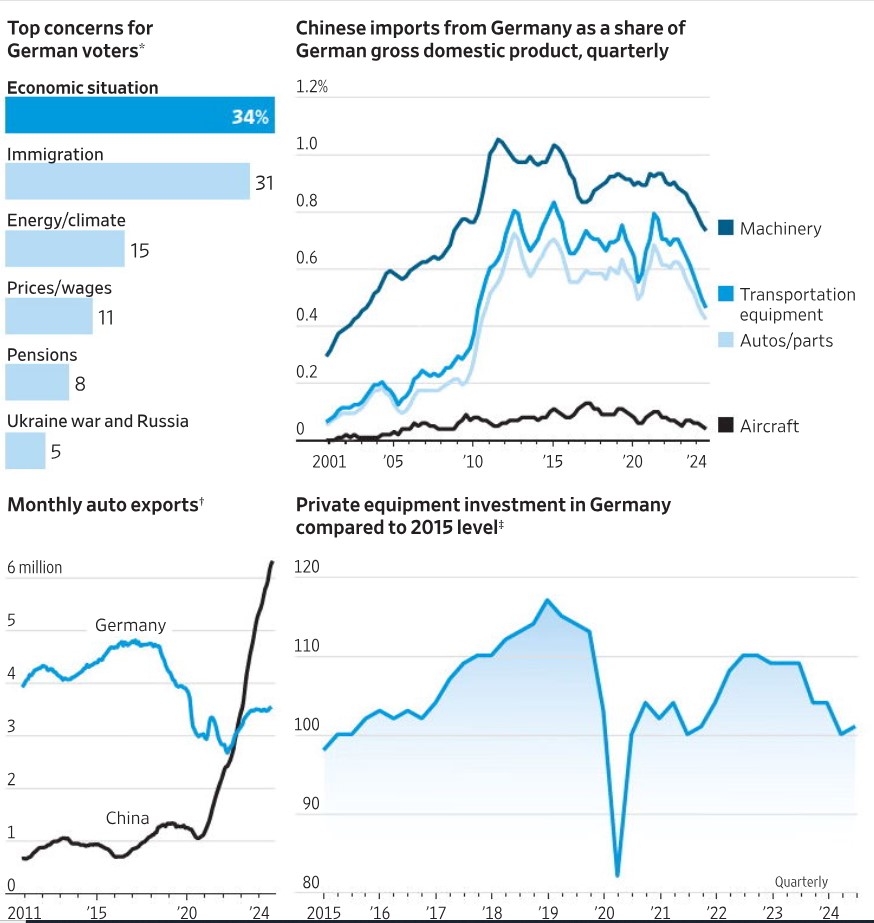
One of the most striking trends is the reversal in monthly auto exports between Germany and China. Historically, Germany exported far more vehicles than China. However, since 2023, Chinese auto exports have skyrocketed, surpassing German levels. This surge highlights China’s growing dominance in the global automotive industry, particularly in the electric vehicle (EV) sector, where Chinese manufacturers have become highly competitive.
Germany’s traditional advantage in auto manufacturing is now under pressure. The rapid rise of Chinese car exports suggests that German automakers must innovate and adapt quickly to maintain their global market share. Germany’s economic landscape is at a crossroads. The decline in exports to China, the rise of Chinese auto dominance, and the fluctuating investment trends all point to structural challenges that require urgent attention. Policymakers must address these shifts by fostering innovation, supporting key industries, and exploring new trade partnerships.
Additionally, German businesses must adapt to changing global dynamics by investing in emerging technologies, strengthening domestic production, and diversifying export markets. The country’s industrial and economic strategies in the coming years will determine whether Germany can maintain its global leadership in manufacturing and trade.
Germany’s economic concerns are more pressing than ever, as reflected in voter sentiment, trade shifts, and investment patterns. The nation must navigate these challenges strategically to sustain growth and competitiveness in the evolving global economy. The coming years will be crucial in shaping Germany’s economic future amid increasing international competition and shifting trade alliances.