


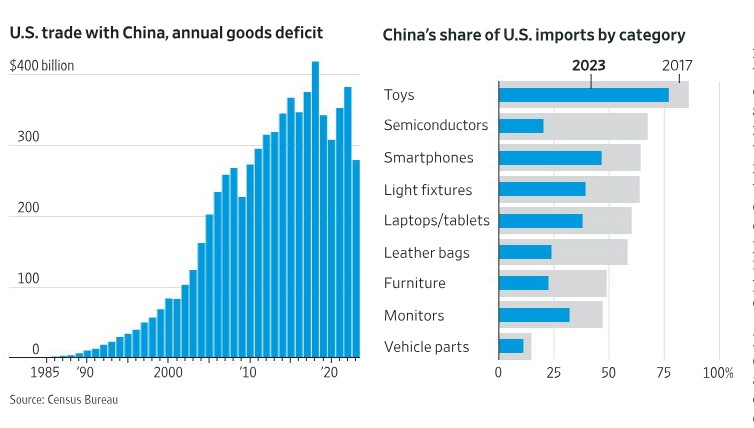
The U.S.-China trade relationship has been a focal point of economic and political discussions for decades. The U.S.-China trade relationship has been a focal point of economic and political discussions for decades. As illustrated in the provided chart, the U.S. trade deficit with China has grown substantially since the 1980s, reaching a peak of over $400 billion. Additionally, China’s share of U.S. imports across various categories has shifted over time. This article explores the trends, causes, and implications of the U.S. trade deficit with China.
Historical Growth of the U.S.-China Trade Deficit The trade deficit between the United States and China has expanded significantly since the 1980s. Initially, trade between the two nations was relatively balanced. However, as China became a global manufacturing hub, its exports to the U.S. surged. By the 2000s, the deficit exceeded $100 billion, and it continued to rise, peaking in the late 2010s.
In recent years, the trade deficit has seen fluctuations due to multiple factors. Trade tensions between the U.S. and China led to tariff impositions, which slightly reduced the deficit from its peak. Additionally, the COVID-19 pandemic disrupted supply chains, leading to changes in import patterns. Despite these factors, the trade imbalance remains significant.
China’s Share of U.S. Imports by Category
China’s Share of U.S. Imports by Category The second chart highlights the share of U.S. imports from China across different categories in 2023 compared to 2017. Notably:
- Toys remain a dominant import from China, though their share has slightly declined.
- Semiconductors and Smartphones – While still significant, their share has decreased due to diversification efforts by U.S. firms and increased production in other countries.
- Furniture, Monitors, and Vehicle Parts – These categories have also seen a reduction in China’s share of U.S. imports.
These shifts indicate a broader trend of supply chain diversification, with the U.S. seeking alternative suppliers in response to geopolitical tensions and economic strategies.
Implications of the Trade Deficit The U.S.-China trade deficit has far-reaching consequences:
- Economic Impact – While consumers benefit from lower prices, domestic industries face stiff competition from Chinese manufacturers.
- Employment Concerns – The outsourcing of manufacturing jobs to China has contributed to job losses in certain U.S. sectors.
- Geopolitical Tensions – The trade imbalance has been a source of contention in U.S.-China relations, influencing policies on tariffs, supply chain security, and national security concerns.
The U.S.-China trade deficit remains a complex issue influenced by economic policies, global trade dynamics, and consumer behavior. While efforts to reduce reliance on Chinese imports are underway, China continues to play a crucial role in global trade. Moving forward, a balanced approach that fosters economic cooperation while protecting domestic industries will be essential in managing the trade relationship between the two economic giants.