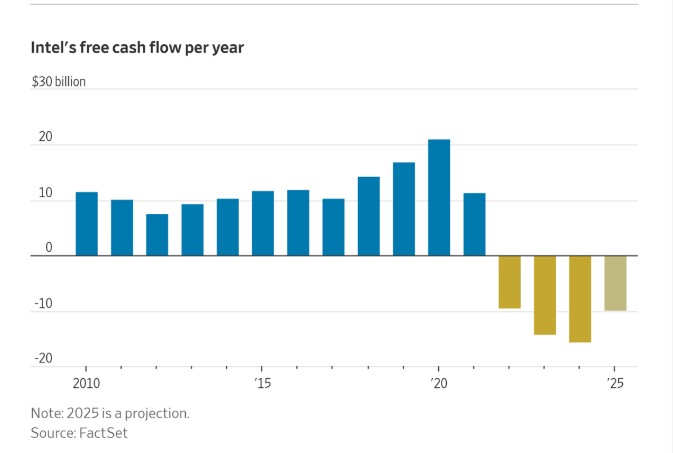
For three consecutive years, Intel Corporation has been burning through cash as it executes an ambitious turnaround plan to regain its dominance in the semiconductor industry. The company’s free cash flow has remained negative for the past three years, a stark contrast to its historically strong balance sheet. In 2022 alone, Intel reported a cash burn of $9.5 billion, followed by $14 billion in 2023, as it aggressively ramped up capital expenditures. The trend continued into 2024, with the company committing tens of billions more to manufacturing expansion. The primary driver behind this cash drain is Intel’s massive investment in new fabrication plants, aimed at regaining process node leadership from Taiwan Semiconductor Manufacturing Company (TSMC). These facilities, such as the multi-billion-dollar fabs in Arizona, Ohio, and Europe.
Intel’s struggle to develop its 7nm and 5nm process technologies on schedule has cost it dearly. Manufacturing setbacks and design flaws have led to lost contracts and frustrated customers. In response, Intel has pivoted toward becoming a major contract chipmaker, competing directly with TSMC and Samsung in the foundry business.
Challenges and Risks
While Intel’s plan is bold, significant challenges remain. Competing with TSMC and Samsung in the foundry space will require not just massive capital investment but also technological breakthroughs. Additionally, Intel’s execution risks—historically a weak point—must be addressed to prevent further delays.
Geopolitical factors also loom large. The ongoing tensions between the U.S. and China could disrupt Intel’s supply chains and customer base, impacting profitability. Moreover, the AI revolution, dominated by NVIDIA, threatens to shift industry dynamics in ways that Intel may struggle to keep up with.
Investor Sentiment and Market Response
Intel’s stock has been volatile as investors weigh the potential for long-term gains against near-term financial strain. While some analysts remain optimistic about Intel’s strategic pivot, others warn that execution missteps could lead to further declines. The success of Intel Foundry Services and the timely launch of advanced process nodes will be critical in shaping the company’s future trajectory.