


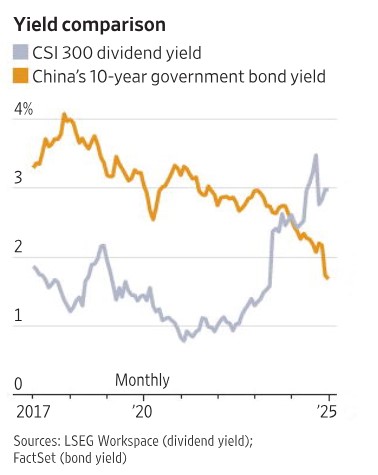
In recent years, Chinese investors have increasingly turned to dividends as a key source of returns. With bond yields declining, particularly China’s 10-year government bond yield, equity dividends have become an attractive alternative. This shift reflects a broader trend where investors seek stable income streams amid economic uncertainty and shifting financial policies. This article explores the factors driving this transition and its implications for China’s stock market and broader economy.
Declining Bond Yields and Market Conditions
China’s 10-year government bond yield has been on a downward trend, as shown in the accompanying graph. The decline is driven by various factors, including monetary easing policies by the People’s Bank of China (PBOC), slower economic growth, and reduced inflationary pressures. Lower bond yields make fixed-income investments less attractive, prompting investors to look for alternative sources of returns.
Why Investors Prefer Dividends
Investors are drawn to dividends for several reasons:
- Stable Income: Dividends provide a reliable source of income, especially when bond returns are low.
- Hedge Against Inflation: Unlike fixed-income securities, dividend-paying stocks often provide returns that outpace inflation.
- Confidence in Corporate Health: Companies that consistently pay dividends signal strong financial health and stability.
- Attractive Valuations: As stock prices fluctuate, rising dividend yields make certain stocks more attractive to value investors.
Impact on the Chinese Stock Market
With more investors shifting toward dividend-paying stocks, several effects can be observed:
- Increased Demand for Blue-Chip Stocks: Large-cap companies with strong dividend histories, such as those in the financial and consumer sectors, have become more attractive.
- Lower Market Volatility: Dividend-paying stocks tend to be less volatile compared to high-growth, non-dividend-paying stocks.
- Shift in Investment Strategies: Institutional and retail investors are adjusting their portfolios to favor dividend-generating assets over speculative growth stocks.
Future Outlook
The shift toward dividend investing is likely to continue if bond yields remain low. Factors that could influence this trend include:
- Government Policies: Further monetary easing or economic stimulus could push bond yields lower, making dividends even more attractive.
- Corporate Dividend Policies: If companies continue increasing their dividend payouts, investors will likely maintain their focus on dividend income.
- Global Market Influence: Comparisons with other markets, such as the U.S. and Europe, may encourage Chinese firms to maintain strong dividend policies to remain competitive.
Our Opinion
Chinese investors are adapting to a changing financial landscape by focusing on dividend-paying stocks. As bond yields decline, dividends offer a viable alternative for stable returns, making them an essential component of investment strategies. Whether this trend will persist depends on economic conditions, corporate behavior, and government policies. For now, dividends remain a compelling choice for investors seeking income and stability in uncertain markets.