


Historically, the BoE has raised interest rates to curb inflationary pressures, as seen in the early 2020s when inflation spiked due to global supply chain disruptions and energy price surges following geopolitical events. However, as inflationary pressures have eased and economic growth has slowed, the BoE has signaled a shift toward a more accommodative monetary policy, culminating in the recent rate cut to 4.5%.
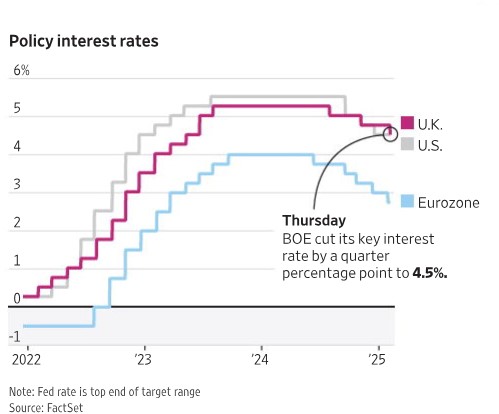
The chart provided illustrates the trajectory of policy interest rates for the UK, the U.S., and the Eurozone from 2022 to early 2025. For the UK, the BoE’s rate increased steadily from 2022, peaking at around 5.25% in mid-2023, before stabilizing and then declining to 4.5% as of March 2025. This downward adjustment reflects a deliberate move to stimulate economic activity amid signs of cooling inflation and sluggish growth.
In comparison, the U.S. Federal Reserve (Fed) maintained a relatively stable rate, hovering around 4% to 4.5% over the same period, with slight fluctuations. Meanwhile, the European Central Bank (ECB), overseeing the Eurozone, followed a similar but lower path, with rates decreasing to around 3% by early 2025. The divergence in these trajectories highlights the unique economic challenges faced by each region, with the BoE’s decision underscoring its focus on supporting the UK’s recovery.
Several factors likely influenced the BoE’s decision to cut rates on March 3, 2025. First, UK inflation, which peaked at over 11% in late 2022 due to rising energy costs and supply chain issues, has steadily declined toward the BoE’s 2% target. By early 2025, inflation is likely hovering around 2% to 3%, allowing the central bank to ease monetary policy without risking a resurgence of price pressures.
Risks and Challenges Ahead
While the BoE’s rate cut is a positive step for the UK economy, it is not without risks. If inflation begins to rise again—perhaps due to unexpected global shocks, such as oil price spikes or trade disruptions—the BoE may need to reverse course and raise rates, potentially stifling growth. Additionally, lowering rates too aggressively could fuel asset bubbles, particularly in the housing market, leading to long-term instability.
Another challenge is the global economic environment. The UK’s economy is highly integrated with international markets, and any downturn in major economies like the U.S. or China could offset the benefits of the rate cut. The BoE must carefully monitor these external factors while balancing its domestic objectives.
Our opinion
The Bank of England’s decision to cut its policy interest rate to 4.5% , represents a strategic move to support the UK’s economic recovery. By lowering borrowing costs, the BoE aims to stimulate growth, boost employment, and maintain price stability in an environment of moderating inflation. While the rate cut aligns with global trends of monetary easing, it also reflects the UK’s unique economic challenges, including post-Brexit adjustments and sluggish growth.
As the UK navigates this critical period, the BoE’s actions will be closely watched by policymakers, businesses, and households alike. The success of the rate cut will depend on a range of factors, from domestic consumer confidence to global economic stability. For now, the BoE’s cautious yet proactive approach offers hope for a balanced recovery, positioning the UK to thrive in an uncertain world.