

In a recent analysis, UBS, one of the world’s leading financial institutions, has raised concerns that stock market volatility, as measured by the CBOE Volatility Index (VIX), may be significantly mispriced. The warning comes as investors navigate an increasingly uncertain global landscape, with a series of political events on the horizon that could trigger sharp market fluctuations.
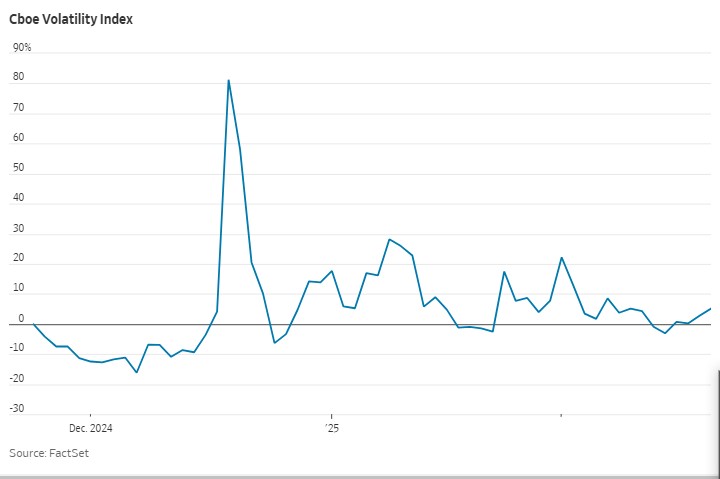
The CBOE Volatility Index, often referred to as the “fear gauge,” tracks the market’s expectations of near-term volatility conveyed by S&P 500 stock index option prices. A chart of the VIX from December 2024 to February 2025, provided by FactSet, illustrates a striking pattern: after a period of relatively low volatility, the index spiked dramatically in early 2025, reaching levels above 70% before settling into a more subdued, yet still fluctuating, range near 0% to 10% by late February.
UBS analysts argue that this apparent stabilization does not accurately reflect the risks looming over global markets. “The current pricing of volatility suggests a complacency that could leave investors exposed,” said Jane Carter, a senior strategist at UBS. “We’re seeing a disconnect between market expectations and the potential for disruption driven by political uncertainties.”
Political Risks on the Horizon
UBS highlighted several key political developments that could unsettle financial markets in the coming months:
- U.S. Presidential Election Aftermath: With the U.S. presidential election cycle concluding in late 2024, the implementation of new policies—whether economic, trade, or regulatory—could create market turbulence. Any delays in policy execution or unexpected shifts in leadership priorities might amplify volatility.
- Geopolitical Tensions: Ongoing tensions in regions like Eastern Europe, the Middle East, and Asia-Pacific could escalate, impacting oil prices, supply chains, and investor sentiment. UBS pointed to potential flare-ups in trade disputes or military conflicts as significant risk factors.
- European Political Shifts: Several European countries are bracing for national elections and referendums in 2025, which could lead to shifts in fiscal policies, EU relations, and economic stability. The rise of populist movements in key economies adds another layer of uncertainty.
- Central Bank Policy Divergence: Differing monetary policies among major central banks, including the Federal Reserve, European Central Bank, and others, could create currency volatility and affect global equity markets. UBS warned that unexpected rate changes or hawkish/dovish pivots could catch markets off guard.
What the VIX Chart Reveals
The CBOE Volatility Index chart underscores the market’s sensitivity to sudden shocks. The sharp peak in early 2025 likely reflects a major event—possibly a geopolitical crisis or a significant policy announcement—that sent investors scrambling for protection. However, the subsequent decline to low levels raises questions about whether the market is underestimating future risks.
“Volatility isn’t just a number—it’s a signal,” Carter explained. “The VIX’s current low reading might give a false sense of security. We’re advising clients to prepare for potential spikes driven by these political uncertainties.”
Investor Implications
UBS recommends that investors reassess their portfolios, considering hedging strategies such as options or volatility-linked products to mitigate risk. The firm also suggests diversifying across asset classes and geographies to buffer against localized shocks.
While the stock market has shown resilience in recent months, UBS cautions that the interplay of political events could quickly reverse this trend. “Markets are forward-looking, but they’re not infallible,” Carter noted. “A single unexpected development could reignite volatility, and investors need to be ready.”
As of March 2025, with the political calendar heating up and global tensions persisting, UBS’s call to action serves as a timely reminder for investors to stay vigilant. Whether the VIX remains subdued or surges again, the mispricing of volatility could prove to be a costly oversight for those unprepared for the road ahead.