
The “Magnificent Seven” has become a term synonymous with the most influential tech giants in the U.S. stock market: Apple, Microsoft, Alphabet (Google), Amazon, Nvidia, Tesla, and Meta (Facebook). These companies have not only reshaped industries but also dominated the S&P 500 in terms of market value and earnings growth over the past five years. Two charts from FactSet provide a compelling visual story of their performance from 2020 to 2025, highlighting their corporate earnings growth relative to the rest of the S&P 500 and their increasing share of the index’s market value.
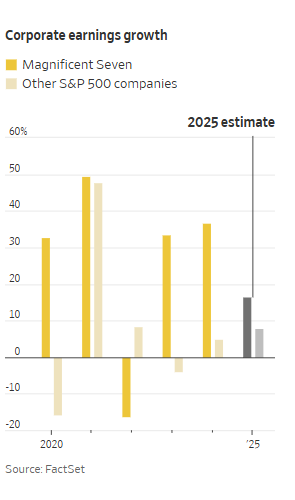
In 2020, the Magnificent Seven posted earnings growth of around 30%, while the rest of the S&P 500 saw a decline of approximately 10%. This disparity underscores the resilience of tech companies during the pandemic, as remote work, e-commerce, and digital services surged. By 2021, the gap widened further: the Magnificent Seven’s earnings growth soared to over 50%, while the rest of the S&P 500 rebounded to about 10% growth. This period marked the peak of tech-driven market performance, fueled by low interest rates and high demand for tech solutions.
However, 2022 tells a different story. The Magnificent Seven experienced a sharp decline, with earnings growth dropping to around -15%, likely due to rising interest rates, supply chain issues, and a post-pandemic slowdown in digital demand. The rest of the S&P 500 also saw negative growth, around -5%, but the tech giants were hit harder. In 2023, both groups recovered, with the Magnificent Seven achieving roughly 30% growth and the rest of the S&P 500 at 5%. The trend continued into 2024, with the Magnificent Seven at 20% and the rest at 0%. For 2025, estimates suggest a decline for both, with the Magnificent Seven at 10% and the rest at -5%.
The Magnificent Seven’s outperformance in earnings growth can be attributed to several key factors. First, their business models are rooted in scalable technology, allowing them to capitalize on global trends like digital transformation. For example, during the pandemic, Amazon benefited from e-commerce growth, while Microsoft and Alphabet saw increased demand for cloud computing services. Nvidia’s explosive growth in 2023 and 2024 was driven by the AI boom, with its GPUs powering generative AI models.
Second, these companies have significant cash reserves, enabling them to invest heavily in research and development. Apple’s focus on ecosystem expansion (e.g., wearables and services) and Tesla’s advancements in battery technology are prime examples. Third, their global reach and diversified revenue streams provide a buffer against regional economic downturns, unlike many smaller S&P 500 companies that rely on specific sectors or geographies.
However, the declines in 2022 and the projected slowdown in 2025 highlight vulnerabilities. Rising interest rates in 2022 increased borrowing costs and reduced the present value of future cash flows, hitting growth stocks like tech companies hardest. Additionally, regulatory scrutiny—such as antitrust investigations into Alphabet and Meta—may have dampened investor confidence and growth prospects.
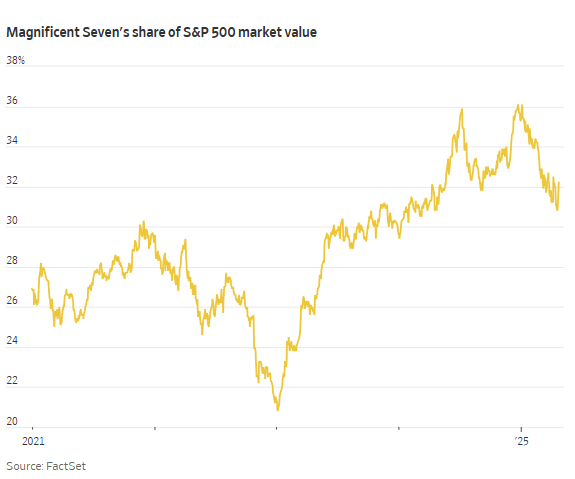
For investors, this poses a challenge. Index funds and ETFs tracking the S&P 500 are disproportionately exposed to these tech giants, meaning a downturn in the Magnificent Seven could drag down the entire index. Moreover, the underperformance of the “Other S&P 500” in earnings growth suggests that the broader market is struggling to keep pace, potentially stifling innovation and growth in other sectors like healthcare, energy, or industrials.