

Two American retail titans are on the front lines in President Trump’s trade war. Investors seem to be betting that Walmart can dodge even more bullets than Amazon.
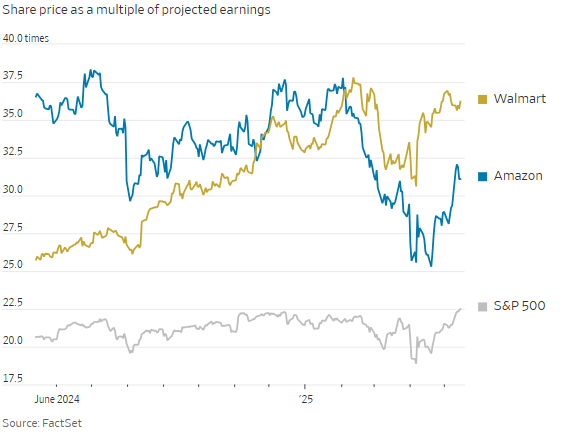
That has landed Walmart—the home of “Always Low Prices”—a rather rich multiple of 37 times projected earnings for the next four quarters, which is 40% above its three-year average, according to FactSet data. Amazon now trades around 33 times forward earnings.
Such a premium leaves Walmart very little room for error in a world where so much can go wrong. Walmart noted that more than two-thirds of the goods it sells in U.S. stores come from the U.S. “But given the magnitude of the tariffs, even at the reduced levels announced this week, we aren’t able to absorb all the pressure given the reality of narrow retail margins,” Walmart Chief Executive Doug McMillon said.
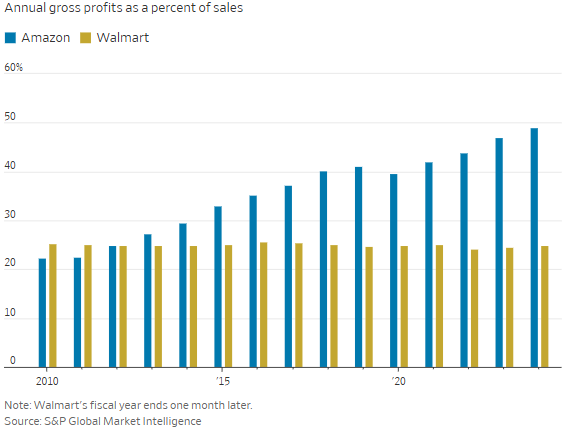
“Narrow retail margins” are a challenge for Amazon as well. But the company has spent many years building up ancillary and adjacent businesses such as cloud computing and advertising that provide far more financial firepower.
Amazon and Walmart commanded similar gross margins in the mid-20% range a little over a decade ago, according to data from S&P Global Market Intelligence. Walmart’s has stayed in that range, while Amazon’s annual gross margin has nearly doubled—hitting 49% last year.
Walmart has done a commendable job of becoming more than just an enormous physical retailer. E-commerce revenue hit $32.5 billion in the April-ending quarter, up 22% from the same period last year and now making up 20% of the company’s total sales. That has allowed Walmart to follow in Amazon’s footsteps and build up new, higher-margin revenue streams from subscriber fees and advertising. Bernstein analyst Zhihan Ma says Walmart is on a “fundamentally improved” earnings trajectory over the long term.
Both companies are projected to hit roughly $700 billion in revenue this year, Wall Street expects Amazon’s operating income to come in around 2½ times that of Walmart’s at more than $77 billion for Amazon, according to FactSet estimates.
Even after factoring in the costs of Amazon’s aggressive artificial intelligence investments and the launch of its own satellite network. These businesses are also less tied to the overall retail environment than Walmart’s ancillary businesses such as advertising, making them a better hedge against tariff chaos.
Walmart’s scale and execution give it a distinct edge over other traditional retailers in an environment of rising prices and worried consumers.