
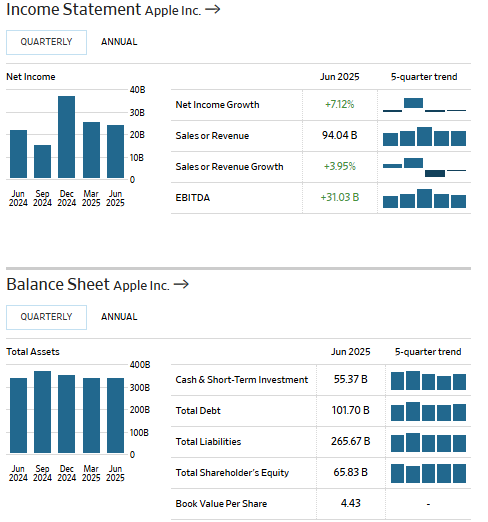
Apple reported third-quarter earnings that topped Wall Street expectations for profit and revenue.
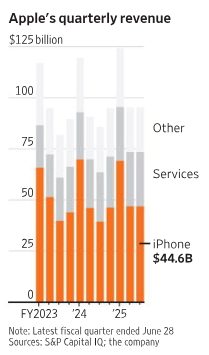
iPhone sales grew 13% year over year and overall revenue grew 10% — Apple’s largest quarterly revenue growth since December 2021.
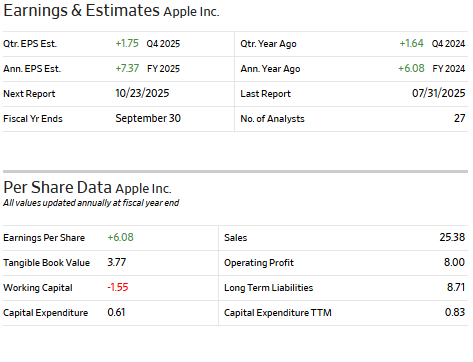
✅Earnings per share: $1.57 vs. $1.43 expected
✅Revenue: $94.04 billion vs. $89.53 billion expected
✅iPhone revenue: $44.58 billion vs. $40.22 billion expected
✅Mac revenue: $8.05 billion vs. $7.26 billion expected
✅iPad revenue: $6.58 billion vs. $7.24 billion expected
✅Other Products revenue: $7.40 billion vs. $7.82 billion expected
✅Services revenue: $27.42 billion vs. $26.80 billion expected
✅Gross margin: 46.5% vs. 45.9% expected
The company provided what it calls color about the company’s performance during the September quarter so far on a call with analysts. Apple said it expects mid- to high-single-digit increases in overall revenue, services growth to be similar to this quarter’s 13% year-over-year growth and for gross margin to be between 46% and 47%, even including costs related to tariffs.
Apple incurred $800 million in tariff costs in the June quarter, Apple CEO Tim Cook said on the call. That came in lower than the $900 million estimate the company provided in May. For the September quarter, assuming no changes, Apple could incur about $1.1 billion in tariff costs, Cook said.
The company reported $1.57 in earnings per share or $24.43 billion of net income during the quarter, versus $1.40 per share or $21.45 billion in the year-ago period.
Download NOW Q2 2025 Technology sector including Apple evaluation
Apple’s Mac business grew the fastest of any of Apple’s units during the June quarter, growing nearly 15% to $8.05 billion in revenue. Apple released updated MacBook Air laptops, its best-selling Mac, just before the quarter started.
The company’s services business, which includes Apple’s warranties, content subscriptions, licensing deals with Google and iCloud continued to grow to $27.42 billion in the period, a 13% increase.
The two tougher spots in Apple’s report were iPad sales and the company’s other products division, which it sometimes calls its wearables. It consists of Apple Watch, AirPods and other accessories. Revenue for iPad was down 8% to $6.58 billion, despite the company launching a low-cost iPad in March. Apple’s wearables unit declined 8.64% to $7.4 billion during the quarter.
Apple also saw success in China during the quarter, with sales rising 4% on an annual basis to $15.37 billion. Apple reports its sales from China, Hong Kong and Taiwan in the same unit. It’s a reversal from the past two quarters, where Apple’s China sales declined 2% in Apple’s second fiscal quarter and 11% in the first quarter.