

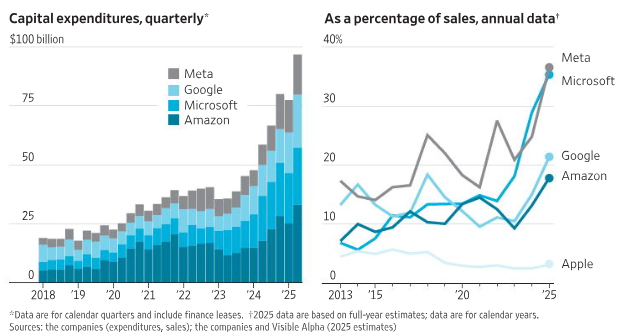
The technology sector is witnessing an extraordinary surge in capital expenditures that fundamentally reshapes how we understand corporate investment strategies. Recent data reveals that major technology companies—Meta, Google, Microsoft, Amazon, and Apple—have collectively increased their quarterly capital spending from modest levels around $10-15 billion in 2018 to staggering heights approaching $100 billion by 2025. This represents one of the most dramatic shifts in corporate spending patterns in modern business history.
The magnitude of this investment surge becomes even more striking when examined as a percentage of annual sales. While traditional technology spending typically ranged between 5-15% of revenue, we’re now seeing companies like Meta and Microsoft allocating over 30% of their annual sales to capital expenditures. This dramatic increase signals a fundamental transformation in how these companies view infrastructure investment—not as a cost center, but as a strategic imperative for future competitiveness.
Amazon has maintained consistently high capital expenditure levels throughout this period, reflecting its mature cloud infrastructure business and continued expansion of fulfillment centers. However, even Amazon’s substantial baseline spending pales in comparison to the explosive growth demonstrated by Meta and Microsoft in recent quarters. Google’s investment trajectory shows steady, sustained growth, while Apple’s spending has remained relatively modest, reflecting different strategic priorities and business models.
The AI Infrastructure Imperative
The driving force behind this unprecedented capital expenditure surge is the race to build artificial intelligence infrastructure. Companies are investing billions in specialized hardware, data centers, and computing resources necessary to train and deploy large language models and other AI systems. This isn’t merely about staying competitive in existing markets—it’s about positioning for what many executives believe will be the next fundamental platform shift in technology.
Meta’s dramatic increase in capital spending, reaching levels that represent over 30% of annual revenue, reflects CEO Mark Zuckerberg’s bet on the metaverse and AI-driven experiences. The company is simultaneously building virtual reality hardware capabilities while investing heavily in the computational infrastructure needed to power sophisticated AI models. This dual investment strategy explains why Meta’s capital expenditure growth has been among the most dramatic in the sector.
Microsoft’s capital spending surge aligns directly with its Azure cloud services expansion and its partnership with OpenAI. The company is racing to build the computational infrastructure necessary to serve enterprise AI customers while also investing in consumer AI applications. Microsoft’s spending as a percentage of revenue has climbed steadily, reaching levels comparable to Meta’s, indicating the company’s commitment to capturing market share in the AI services sector.
The timing of these investments reveals strategic thinking about market positioning. Companies that establish dominant infrastructure positions early in the AI revolution may enjoy sustainable competitive advantages for years to come. The capital intensity required to build state-of-the-art AI training facilities creates natural barriers to entry, potentially cementing the positions of companies willing to make these massive upfront investments.
Financial Implications and Market Dynamics
This capital expenditure surge carries profound implications for financial markets and investor expectations. Companies are essentially asking shareholders to accept lower near-term returns in exchange for potentially dominant positions in future AI markets. The scale of investment required means that even technology giants with substantial cash flows must make difficult allocation decisions, potentially reducing other forms of investment or shareholder returns.
The quarterly data reveals that this isn’t a temporary spike but rather a sustained trend that has accelerated over several years. Starting from relatively modest levels in 2018-2019, capital expenditures have grown consistently, with dramatic acceleration beginning in 2022-2023. This timeline corresponds with the emergence of generative AI as a mainstream technology and the realization among technology leaders that AI infrastructure would require unprecedented levels of investment.
Apple’s more restrained capital expenditure growth, maintaining levels well below other major technology companies, reflects a different strategic approach. Apple’s business model relies more heavily on premium hardware sales and services tied to its ecosystem, requiring less investment in large-scale computational infrastructure. However, Apple’s relatively lower capital intensity may create challenges if AI capabilities become central to consumer device experiences.
The competitive dynamics created by this investment surge extend beyond the technology sector. Companies in other industries that depend on AI capabilities may find themselves increasingly dependent on the infrastructure built by these technology giants. This creates potential bottlenecks and raises questions about market concentration in critical AI infrastructure.
Looking ahead, the sustainability of these investment levels will depend on whether the promised returns from AI applications materialize. Companies are making unprecedented bets that AI will generate sufficient revenue growth to justify current capital expenditure levels. The success or failure of these investments will likely shape technology industry dynamics for the next decade, determining which companies emerge as the dominant platforms for the AI economy.
The current trajectory suggests that capital expenditure levels may continue growing, particularly as competition intensifies and new AI capabilities require even more sophisticated infrastructure. However, investor patience for these massive investments won’t last indefinitely, creating pressure for companies to demonstrate meaningful returns from their AI infrastructure bets in the coming quarters.