


In the first quarter of 2025, the stock performance within the healthcare and biotech sectors has shown a wide divergence. This analysis focuses on the trends of major players and indices, including Vertex Pharmaceuticals, Gilead Sciences, the NYSE Arca Pharmaceutical Index, and the SPDR S&P Biotech ETF. With volatility across the sector, understanding these trends offers insights into investor sentiment, innovation potential, and broader market forces affecting healthcare equities.
The healthcare sector is a critical component of the global economy, encompassing pharmaceutical companies, biotechnology firms, medical device manufacturers, healthcare providers, and insurers. It is influenced by factors such as regulatory changes, scientific innovation, demographic shifts, and macroeconomic trends. In 2025, the sector has faced both opportunities and challenges—ranging from the commercialization of cutting-edge therapies to increasing pressure on pricing and reimbursement.
Vertex Pharmaceuticals and Gilead Sciences have outperformed the broader pharmaceutical and biotech indices significantly. In contrast, the SPDR S&P Biotech ETF has struggled, underperforming even the NYSE Arca Pharmaceutical Index. These disparities reflect market confidence in individual firms with strong pipelines and earnings versus a general cautiousness toward the broader biotech industry.
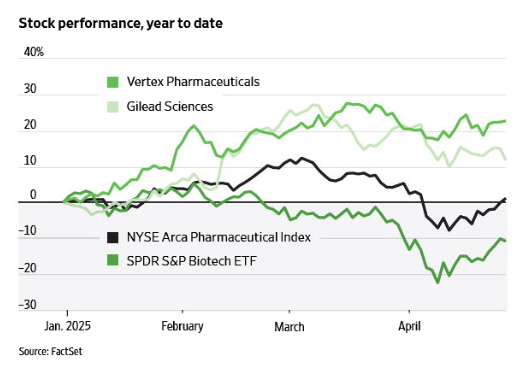
Vertex Pharmaceuticals has led the sector with a performance increase approaching 30% year to date. This strong uptrend, particularly from mid-January to early March, signals investor confidence, likely driven by robust clinical data and solid earnings. Vertex’s leadership in cystic fibrosis treatment and continued R&D innovation have made it a standout performer.
Gilead Sciences has also posted impressive gains, though slightly below Vertex. Peaking around a 25% increase in March, Gilead reflects a positive outlook due to its antiviral portfolio, particularly in HIV and hepatitis, as well as new pipeline drugs. Both companies benefit from stable revenue bases, strong balance sheets, and investor belief in their long-term growth.
This divergence from the indices suggests that investors are favoring companies with proven drug portfolios and financial stability, especially in uncertain macroeconomic environments.
Download now Healthcare sector Q1 2025 evaluation
The NYSE Arca Pharmaceutical Index represents a broader set of pharmaceutical companies. Its performance in early 2025 has remained relatively stable, fluctuating around the 0% mark for most of the period. Though there was a moderate rise in February, the index has since returned to flat levels by late April.
This neutral performance reflects a cautious investor sentiment. While some pharmaceutical companies continue to deliver stable returns, others face patent cliffs, pricing pressures, and regulatory uncertainties. This index serves as a benchmark for traditional pharma but lacks the dynamism of high-performing outliers like Vertex and Gilead.
The sector is also grappling with shifting regulatory policies and payer frameworks that impact drug approval timelines and pricing. Innovation continues to be a driver, but companies must navigate a complex landscape to bring new products to market efficiently.
The SPDR S&P Biotech ETF, which represents a broader swath of smaller biotech firms, has declined significantly in 2025, dropping as much as 25% by mid-April. This sharp decline underscores investor wariness of high-risk, early-stage companies with uncertain cash flows and dependency on favorable trial results.
Biotech stocks tend to be more volatile, and without strong earnings or regulatory approvals, many of these firms become vulnerable in bearish or uncertain market conditions. The ETF’s trajectory has been downward since mid-January, with little sign of a sustained recovery despite a slight uptick in late April.
This trend reflects a broader shift in investor preference toward financially strong companies and away from speculative growth, particularly in a high-interest rate environment where capital is more selective. The underperformance also indicates a possible reassessment of valuations in the biotech sector, especially for firms lacking near-term catalysts.