

Johnson & Johnson JNJ enhanced its annual financial projections following reduced tariff expectations and stronger-than-anticipated second-quarter performance across key metrics.
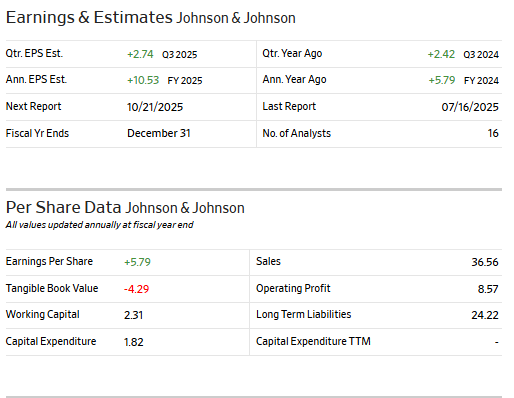
The diversified healthcare corporation announced Tuesday an upward revision to its adjusted earnings per share guidance, now targeting $10.80 to $10.90, representing an increase from the previously established range of $10.50 to $10.70. Wall Street analysts surveyed by FactSet had projected $10.64.
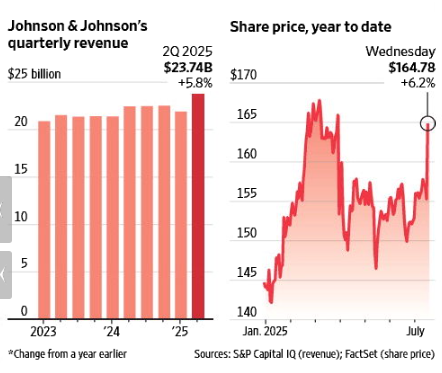
Market response proved favorable, with shares advancing 6.2% to $164.76 on Wednesday. The stock has gained 14% year-to-date.
The revised earnings projection reflects diminished tariff pressures on medical technology imports, according to company leadership. J&J currently estimates approximately $200 million in additional tariff-related expenses, representing a 50% reduction from the $400 million projection issued in April. Management indicated plans to deploy the savings toward accelerating research and development initiatives.
However, the organization maintains that effective tax legislation, rather than tariff policy, remains the primary catalyst for expanding domestic manufacturing capabilities.
“Predicting the ultimate trajectory of tariff policies remains challenging. What we can confidently state is that recently enacted tax legislation is already generating American employment opportunities and fostering innovation,” stated Chief Executive Joaquin Duato during the analyst conference call.
The company simultaneously elevated its annual revenue expectations to a range of $93.2 billion to $93.6 billion, surpassing the previous forecast of $91 billion to $91.8 billion. FactSet consensus estimates had anticipated $91.42 billion in annual sales.
Duato emphasized the company’s positioning for accelerated growth during the latter half of the year, citing anticipated regulatory approvals and submissions across therapeutic areas including lung and bladder cancer, depression, and psoriasis.
Download NOW Healthcare sector Q2 2025
The guidance revision also incorporates beneficial foreign exchange impacts, management noted.
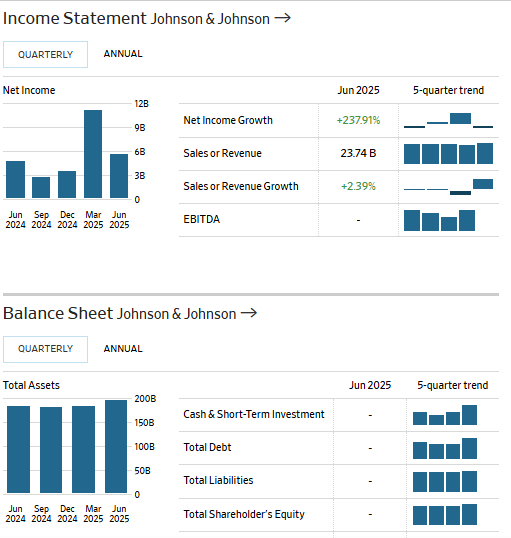
These projections accompanied J&J’s second-quarter results, which showed net income of $5.54 billion, or $2.29 per share, compared to $4.69 billion, or $1.93 per share, in the corresponding period last year.
Adjusted earnings per share reached $2.77, exceeding analyst expectations of $2.68.
Revenue increased 5.8% to $23.74 billion, surpassing the $22.85 billion analyst consensus.
The pharmaceutical division recorded 4.9% growth, propelled by oncology treatments including Darzalex, Carvykti, and Erleada, alongside depression therapy Spravato. This expansion was partially counterbalanced by declining Stelara revenues, as patents for the psoriasis and Crohn’s disease treatment have begun expiring.
Medical device revenues climbed 7.3%, driven by Abiomed, the company’s cardiovascular medical implant device subsidiary, plus increased sales of electrophysiology and wound-closure products.
Strategic Outlook and Market Positioning
Johnson & Johnson’s performance this quarter reflects broader trends within the healthcare sector, where companies are navigating complex regulatory environments while pursuing innovation-driven growth strategies. The company’s ability to adapt its financial projections based on evolving tariff policies demonstrates the agility required in today’s global marketplace.
The pharmaceutical giant’s diversified portfolio continues to provide stability during uncertain economic conditions. With operations spanning consumer products, pharmaceuticals, and medical devices, J&J maintains multiple revenue streams that help offset challenges in any single segment. This strategic positioning has historically enabled the company to weather market volatility while investing in long-term growth opportunities.
Innovation Pipeline and Future Prospects
The company’s emphasis on reinvesting tariff savings into pipeline acceleration underscores its commitment to maintaining competitive advantages through research and development. This approach aligns with industry best practices, where sustained innovation serves as the primary driver of long-term value creation.
Management’s confidence in second-half growth projections stems from a robust pipeline of potential approvals across high-value therapeutic areas. The focus on oncology treatments, particularly in lung and bladder cancer, positions J&J to capitalize on growing market demand for advanced cancer therapies. Similarly, developments in depression treatment and psoriasis management represent significant opportunities in therapeutic areas with substantial unmet medical needs.
Regulatory Environment and Manufacturing Strategy
The company’s nuanced approach to tariff policy versus tax incentives reflects sophisticated strategic planning. While tariff reductions provide immediate financial benefits, J&J’s leadership recognizes that sustainable domestic manufacturing expansion requires comprehensive policy support rather than temporary trade adjustments.
This perspective aligns with broader industry sentiment regarding the importance of stable, long-term policy frameworks for manufacturing investment decisions. The company’s ability to maintain operational flexibility while advocating for favorable policy conditions demonstrates mature corporate governance.
Market Dynamics and Competitive Landscape
J&J’s performance occurs within a competitive healthcare landscape where companies must balance growth investments with immediate financial returns. The company’s ability to exceed analyst expectations while simultaneously raising guidance suggests effective operational execution and strategic positioning.
The medical device segment’s strong performance, particularly through the Abiomed subsidiary, highlights the value of strategic acquisitions in expanding market presence. The 7.3% growth in this segment demonstrates successful integration of acquired capabilities with existing operations.
Financial Resilience and Capital Allocation
The company’s improved financial outlook reflects disciplined capital allocation and operational efficiency improvements. Management’s decision to reinvest tariff savings into pipeline development rather than immediately returning funds to shareholders indicates confidence in internal growth opportunities.
This reinvestment strategy supports long-term value creation while maintaining the company’s reputation for consistent dividend payments and shareholder returns. The balanced approach to capital allocation reflects management’s understanding of investor expectations for both current returns and future growth prospects.
Global Operations and Currency Effects
The favorable foreign exchange effects mentioned in the guidance revision highlight J&J’s global operational footprint. The company’s international presence provides geographic diversification benefits while also creating exposure to currency fluctuations that can impact reported financial results.
Management’s ability to incorporate these currency effects into forward-looking guidance demonstrates sophisticated financial planning and risk management capabilities. This attention to detail in financial forecasting contributes to the company’s reputation for reliable earnings guidance.
Conclusion
Johnson & Johnson’s second-quarter results and updated annual guidance reflect a company successfully navigating complex market conditions while maintaining focus on long-term strategic objectives. The combination of operational excellence, strategic flexibility, and continued innovation investment positions the organization for sustained growth in an evolving healthcare landscape.
The company’s ability to exceed expectations while raising future projections provides investors with confidence in management’s execution capabilities and strategic direction. As J&J continues to advance its pipeline and expand its market presence, the organization appears well-positioned to deliver value to stakeholders across its diverse healthcare portfolio.