Kraft Heinz, one of the world’s largest packaged food companies, has announced plans to unwind its 2015 merger and split into two separate companies. The decision marks a significant turning point for the food giant, which has struggled with shifting consumer preferences, increasing competition, and declining market performance.
The merger between Kraft Foods Group and H.J. Heinz, initially valued at over $45 billion, was once celebrated as a strategic move to create a powerhouse in the global food industry. However, nearly a decade later, the combined company has faced persistent challenges, from changing dietary habits to pressure from private-label brands and healthier food options.
Declining Share Price
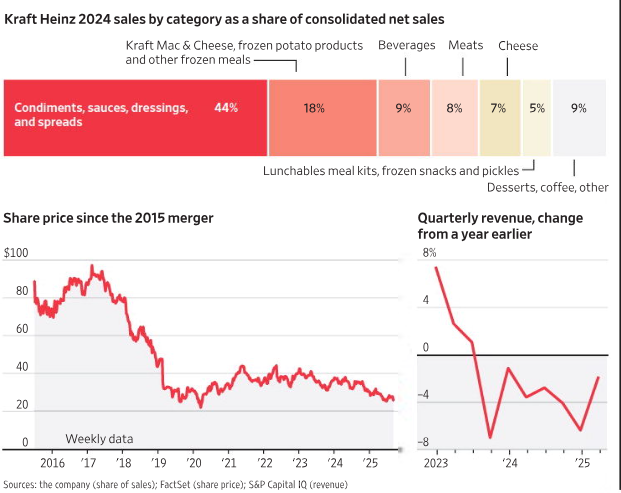
Since the 2015 merger, Kraft Heinz’s stock has lost significant value. As illustrated in the chart, the share price has steadily declined from around $80 in 2017 to under $30 in 2025. This prolonged downturn reflects investor dissatisfaction and the company’s struggle to adapt to market realities.
Sales Breakdown
The company’s 2024 sales reveal heavy reliance on traditional product categories:
- Condiments, sauces, dressings, and spreads: 44%
- Kraft Mac & Cheese, frozen potato products, and other frozen meals: 18%
- Beverages: 9%
- Meats: 8%
- Cheese: 7%
- Lunchables, frozen snacks, pickles: 5%
- Desserts, coffee, other: 9%
This dependency on condiments and processed meals has limited growth potential, as consumer demand shifts toward fresh, natural, and healthier products.
Revenue Challenges
Quarterly revenue changes from 2023 to 2025 show consistent volatility, with multiple quarters posting negative growth. Although there is a recent uptick, the overall trend highlights ongoing instability.
Strategic Rationale for the Split
The decision to split Kraft Heinz into two distinct companies reflects a strategic move to unlock shareholder value and better align with consumer and market dynamics.
- Focused Operations: By separating, each company can concentrate on its strongest product categories and customer bases.
- Growth Opportunities: One entity is expected to focus on condiments, sauces, and spreads, while the other could emphasize meals, cheese, beverages, and frozen products. This targeted approach may foster innovation and more agile responses to consumer trends.
- Investor Confidence: A breakup could reinvigorate investor interest, similar to how other corporate spin-offs in the consumer goods sector have unlocked value.
The separation also provides management teams with clearer accountability, potentially leading to stronger operational execution.
Outlook & Implications
The split of Kraft Heinz into two companies carries broad implications for the food industry, shareholders, and consumers.
- For Shareholders: Investors may benefit from holding stock in two companies with distinct growth strategies. If executed well, the breakup could reverse the long-term decline in share price.
- For the Food Industry: Competitors will closely monitor Kraft Heinz’s restructuring. The move could intensify competition across categories like condiments and ready-to-eat meals.
- For Consumers: Shoppers may see new branding, product innovation, and more targeted marketing as the two companies compete for market share.
While the breakup signals the end of one of the most high-profile mergers in the food sector, it may also mark the beginning of a new chapter—one where the two entities can better navigate modern consumer demands and regain relevance in an evolving marketplace.