

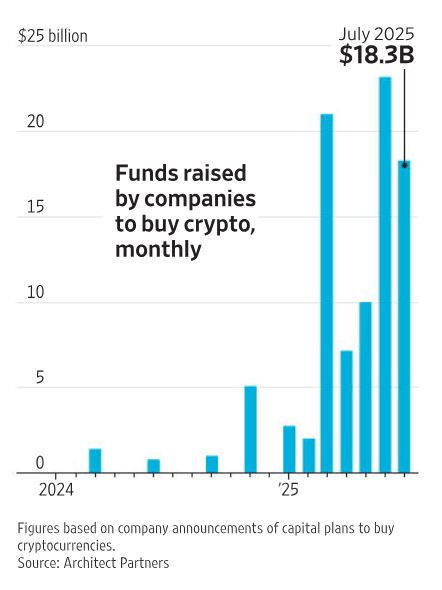
The world of corporate finance has just witnessed a seismic shift. For years, cryptocurrencies were viewed with skepticism, a speculative playground for retail investors and tech-savvy individuals. Now, the tables have turned. According to new data from Architect Partners, companies are raising staggering sums specifically to buy crypto, signaling a fundamental change in how corporate treasuries are managed.
For most of 2024, the amount of capital raised by companies for cryptocurrency purchases was negligible. Then, as 2025 began, something changed. The monthly totals started to climb, slowly at first, but then with an explosive force. The surge culminated in an astounding peak in July 2025, when a record $18.3 billion was raised.
This sudden and unprecedented influx of corporate capital into the crypto market marks a major milestone in the asset class’s journey toward mainstream acceptance. No longer a niche fascination, digital assets are now becoming a core component of some corporate balance sheets. But this begs a crucial question: What’s driving this rush to hold crypto, and why now?
Beyond Speculation: The Corporate Crypto Playbook
The motivations behind this buying spree are more complex than simple speculation. Companies are not just gambling on a price increase; they are developing strategic rationales for holding cryptocurrencies. One of the most significant drivers is the search for a hedge against inflation and currency devaluation. In a volatile macroeconomic environment, traditional fiat currencies face persistent inflationary pressures. Assets like Bitcoin, with its decentralized nature and limited supply, are increasingly viewed as “digital gold”—a more reliable store of value.
Furthermore, companies are seeking genuine portfolio diversification. The performance of traditional stocks and bonds has been unpredictable, and adding a non-correlated asset class like crypto can help mitigate overall portfolio risk. For a company’s treasury department, allocating a small percentage of its cash reserves to crypto can be a prudent way to potentially boost returns and protect purchasing power.
Beyond financial strategy, there’s a forward-looking, technological component at play. Some companies are embracing digital assets as a way to prepare for a future where decentralized finance (DeFi) and blockchain technology are more integrated into commerce. Holding crypto isn’t just a financial investment; it’s a strategic move to better understand and participate in the evolving digital economy. It’s also a powerful public signal. Announcing a significant crypto purchase can position a company as innovative and technologically savvy, which can attract both investors and a new generation of customers.
The Perils and Pitfalls: Navigating a New Asset Class
While the allure of crypto is undeniable, this new trend is far from risk-free. Corporate treasuries are now exposed to a new set of challenges and volatilities. The most immediate risk is price volatility. While the potential for gains is high, so is the risk of a sudden and dramatic downturn. A significant drop in the value of their crypto holdings could severely impact a company’s balance sheet, harm its stock price, and draw the ire of shareholders.
Regulatory uncertainty also looms large. The legal and regulatory landscape for cryptocurrencies is still in its infancy and varies widely across the globe. A sudden change in regulations could impact a company’s ability to hold or use digital assets, potentially leading to unforeseen compliance issues and financial losses.
Another critical concern is security. Unlike traditional cash, which is typically held in banks, digital assets require sophisticated and constant security measures to protect against hacks, phishing scams, and other cyber threats. A security breach could lead to the complete loss of a company’s crypto holdings, a catastrophic event that could undermine its financial stability and reputation.
Finally, there’s the issue of investor scrutiny and accounting. Not all shareholders are on board with a company holding volatile, unregulated assets. This can lead to tension and shareholder activism. Additionally, correctly valuing and reporting these assets on financial statements can be a complex and evolving process, creating potential for accounting discrepancies and confusion.
What’s Next? A Glimpse into the Future
The July 2025 peak of $18.3 billion was a defining moment, but the data also shows a subsequent slight dip in the following month. This raises the question of whether this is a sustainable, long-term trend or simply a fleeting craze. Is the market beginning to cool off, or is this a temporary pause before the next wave of corporate adoption?
The answer likely lies somewhere in the middle. The past two years have shown that corporate interest is not a fleeting phenomenon but a growing movement. As more companies enter the space, the market becomes more stable and institutionalized. This move provides much-needed legitimacy and liquidity to the crypto ecosystem, moving it further away from its wild west reputation and closer to a recognized asset class.
Looking ahead, we can expect to see several key developments. Companies will likely begin to establish dedicated teams and policies for managing digital assets. This institutionalization will bring more sophisticated risk management, security protocols, and strategic planning to the crypto space. The conversation will also likely shift from “why are you buying crypto?” to “what is your crypto strategy?”
We are witnessing the mainstreaming of a revolutionary technology, and corporate treasuries are leading the charge. Whether this shift brings prosperity or peril remains to be seen, but one thing is clear: the relationship between corporations and crypto has just begun.